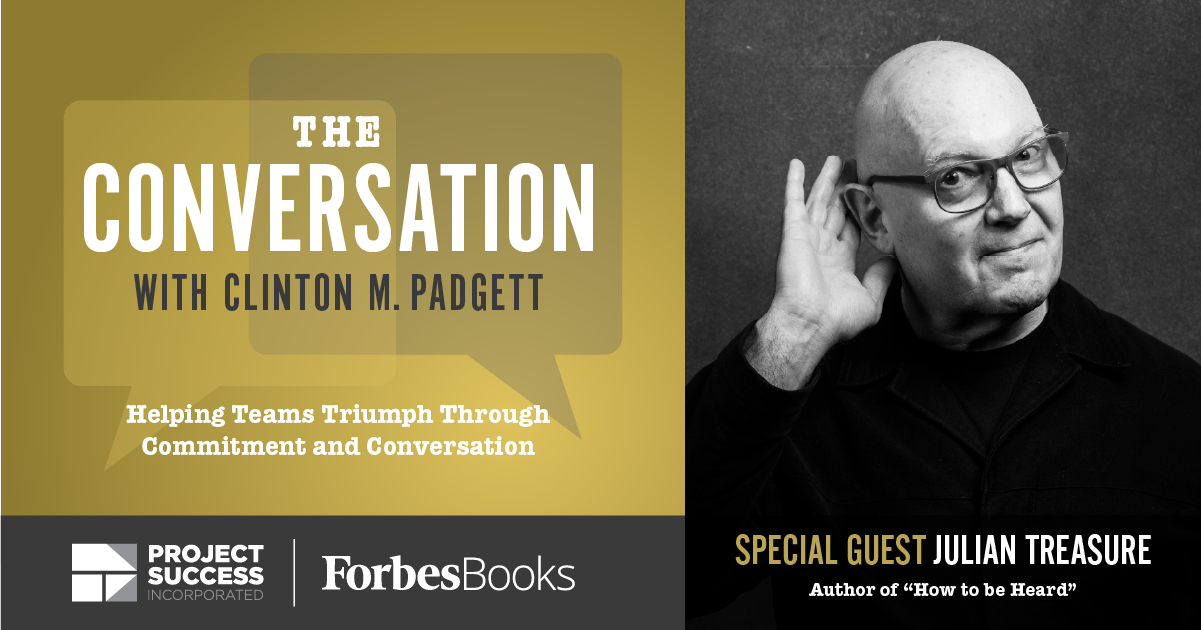



We Have a Listening Crisis: Episode One
In Part One of my conversation with Julian Treasure, award-winning author of How to Be Heard and internationally recognized expert on listening, speaking, and the impact of sound, we explore a skill we all use every day, but few of us are ever taught: listening.
Julian makes an important distinction between hearing and listening. Hearing happens automatically. Listening requires attention and intention. And because each of us listens through our own unique set of experiences, expectations, beliefs, and biases, what someone says isn’t necessarily what another person hears. Julian calls this “speaking into a listening,” and it has significant implications for anyone who leads, communicates, or works with other people.
We also discuss the hidden cost of poor listening in organizations and how conscious listening can improve leadership, relationships, and decision-making. Julian explains how sound affects us physically, emotionally, cognitively, and behaviorally—often without us realizing it—and why noise can have such a profound effect on productivity, learning, and even our well-being.
Our conversation also turns to the environments we create. We tend to design spaces for the eyes while giving far less consideration to the ears. The same is true for brands and organizations: whether they realize it or not, they are communicating through sound. Julian shares a fascinating wine experiment that demonstrates just how much what we hear can influence our perceptions and even our buying decisions.
Perhaps most importantly, Julian challenges leaders to think differently about communication. Rather than focusing only on what we want to say, we need to consider how the other person is prepared to listen. Communication shouldn’t simply be about delivering information. It should be about giving the person receiving it something of value.
Listening Skills for Leaders: Episode Two
In Part Two of my conversation with Julian Treasure, we explore one of the most overlooked communication skills: listening.
We spend years learning how to read, write, and speak, but how many of us have ever been taught how to listen? Julian explains why listening is a skill that can be learned, practiced, and mastered, and why developing that skill is more important than ever in a world increasingly dominated by technology and digital communication.
We discuss the hidden costs of poor listening, the three types of listening, and how becoming more aware of our inner critic can transform the way we communicate. Julian shares practical tools, including his RASA framework for effective listening, the power of simply saying “Tell me more,” and the four communication habits that can undermine even our best intentions: fixing, people-pleasing, looking good, and being right.
We also explore how leaders can build trust and stronger teams through conscious listening, how to navigate disagreements using Julian’s PAVE framework, and why his HAIL principles—Honesty, Authenticity, Integrity, and Love—are essential to powerful speaking.
Along the way, Julian shares insights from his latest book, Sound Affects, and his mission to regenerate the world’s listening.
Because becoming a better communicator isn’t just about learning what to say. It starts with learning how to listen.
EXCLUSIVE LISTENER OFFER
Listeners of The Conversation can receive 25% off Julian Treasure’s new Conscious Communication App, featuring daily micro-lessons designed to strengthen your speaking, listening, and presentation skills. Get the code when you listen to the podcast.
The offer is available to the first 200 people who redeem it.
Learn more and receive 25% off:
https://studio.com/juliantreasure/mcc?c=Y1WUw0Js